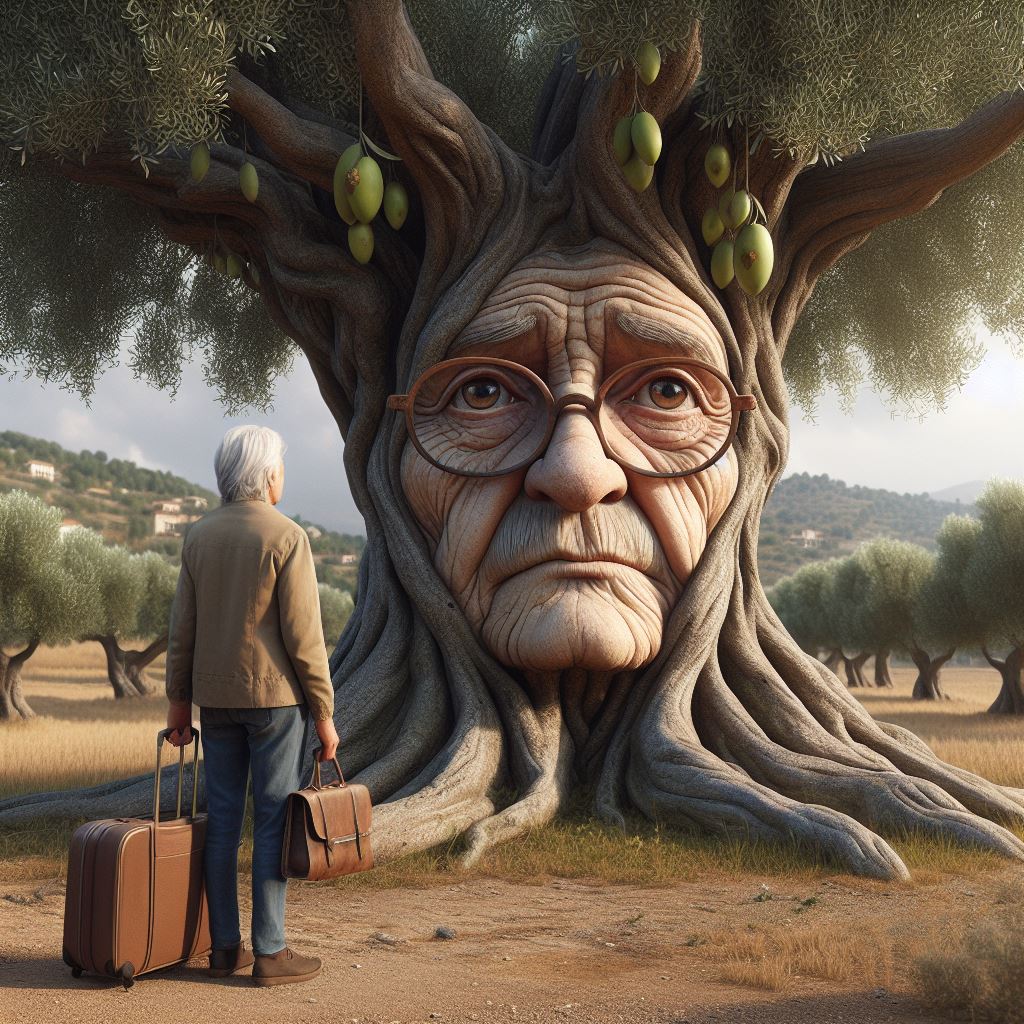
A Moving Human vs a Rooted, Living Tree
The human is mobile.
The tree is, by nature, immobile.
Yet here, the roles are reversed:
we do not see the human’s face
we feel emotion through the tree
the human, though mobile, feels internally frozen
the tree, though rooted, feels deeply alive
A powerful paradox emerges:
Not everything that moves is truly alive.
Not everything that stays is passive.
The tree is no longer just nature.
It is memory. It is witness. It is presence.
2) The Tree as an Elderly Human Face
This is the core metaphor.
The face carries:
age
wisdom
fatigue
memory
patience
endurance
The glasses matter. They symbolize not just humanization, but:
perception
interpretation
awareness
The deeper message:
Nature is not a backdrop.
It is a consciousness that sees, remembers, and understands.
Even deeper:
This is not one individual face.
It feels like the face of generations.
3) The Man Seen from Behind
We never see his face.
This is crucial.
If we did, it would be a personal story.
But now, it becomes universal.
He could be:
someone about to leave
someone who has returned but cannot approach
someone confronting their past
someone standing at the edge of departure or mortality
The suitcase reinforces this.
A powerful interpretation:
Sometimes we carry a suitcase not to leave,
but to understand what we are leaving behind.
4) The Suitcase
The suitcase represents:
migration
departure
impermanence
portable identity
disconnection
escape or return
But here lies a deeper contrast:
The human carries belongings.
The tree carries roots.
The human can move.
The tree cannot.
And yet:
The human escapes physically,
but the tree remains complete.
A sharper message:
Humans believe they are free when they move,
yet they lose depth as they detach from their roots.
5) Roots and Wrinkles
The tree’s texture mirrors human wrinkles.
This is not accidental.
Wrinkles on a face,
roots on a tree—
both are:
maps of time
records of endurance
imprints of lived experience
A profound metaphor:
Time writes on all bodies using the same language.
Whether human or tree,
existence carries the same scars.
6) The Olive Tree Symbolism
The fruits resemble olives.
This adds deep meaning:
Mediterranean heritage
longevity
peace
patience
generational continuity
Olive trees grow slowly but live long.
Thus:
Humans are momentary.
Roots are timeless.
And more emotionally:
What defines us is not where we go,
but which tree’s shadow we came from.
7) The Emotion in the Tree’s Face
The face is not angry.
But not at peace either.
It feels:
disappointed
patient
knowing
silently judging
abandoned, yet present
It seems to say:
“You can leave.
But wherever you go, you came from me.
You can walk away—
but you cannot erase your origin.”
This is deeply ancestral.
Almost parental.
Almost sacred.
The tree becomes:
the face of memory itself.
8) The Silent Dialogue
No words are spoken.
Yet the tension is undeniable.
Questions linger:
Why are you leaving?
Where are you going?
What part of me can you truly carry?
Can roots ever be left behind?
This is not nostalgia.
It is a confrontation with identity.
9) Nature as Subject, Not Background
The tree dominates the frame.
The human becomes secondary.
This inversion suggests:
Humans are not the center of meaning.
They only believe they are.
Here, nature is not observed.
It is observing.
10) The Glasses
At first glance, the glasses humanize the tree.
But deeper:
They symbolize:
intellect
interpretation
cultural awareness
The implication:
Human culture may not be separate from nature.
It may be nature continuing itself in another form.
11) The Deepest Idea: Roots as Consciousness
Roots are not just biological.
They are:
origin
memory
language
family
trauma
culture
childhood
The tree may represent all of these.
Thus:
You can leave physically.
But you cannot abandon what built you.
12) The Final Paradox: Leaving vs Belonging
Movement feels like freedom.
Rootedness feels like limitation.
But the image reverses this:
rootlessness may be drift
staying may be depth
So the hidden question is:
Do humans truly want to leave,
or do they leave because they feel alienated from where they belong?
The Silent Scream
The deepest message:
Humans feel most alone in front of their own roots.
And:
We can build new lives anywhere,
but we cannot carry the source that built us.
Even more sharply:
Humans carry suitcases.
But identity is carried by roots.
by chatgpt
“The Olive Tree and the Old Man”
This image, created by artificial intelligence, is an extremely powerful, emotional, and deeply philosophical piece. At first glance, it appears to be “an old man looking thoughtfully at a tree,” but in reality, it is a profound meditation on the end of life, roots, legacy, and the cycle of existence.
1. Overall Composition
- Main Character: An elderly man with white hair, seen from behind. He is holding a suitcase and an old briefcase → “He has packed up his life and is either leaving or returning.”
- The Giant Olive Tree: The trunk of the tree is shaped exactly like the face of an old man (glasses, deep wrinkles, tired but wise eyes).
- Setting: A classic Mediterranean olive grove (feels like Tuscany, the Aegean, or Southern Anatolia).
2. Major Paradoxes
| Paradox | Explanation | What it says |
|---|---|---|
| 1. Tree = Human | The olive tree’s trunk is the face of an old man | Human and tree are the same being. The man ages and leaves, but the tree remains rooted for thousands of years. |
| 2. The man is looking at the tree, but the tree is the man’s face | He is essentially looking at his own face | “At the end of life, you come face to face with yourself.” |
| 3. Suitcase + Roots | The man is leaving with a suitcase, while the tree stands with thousand-year-old roots | Humans think they are “going somewhere,” but in the end, they always return to their roots. |
| 4. Young olives + Old face | Fresh green olives at the top, but the trunk is extremely old | Life cycle: The body ages, but the legacy (the fruit) continues. |
3. Powerful Metaphors
- Olive Tree: In Mediterranean culture, the olive tree symbolizes immortality, patience, heritage, family, homeland, and roots. It can live for thousands of years. → This tree = Your father, your grandfather, your ancestors, your homeland, your roots.
- The man’s face on the tree: “You are actually that tree. Even if you age and leave, your roots remain.”
- Suitcase + Briefcase:
- Suitcase = Packing up life, migration, return, preparation for death.
- Briefcase = Labor, accumulated legacy, title deeds, will, memories.
- Standing with his back turned: The man is not actually looking at the tree… the tree is looking at him. The tree is saying either “welcome home” or “it’s time to go.”
4. Subliminal / The Screaming Deep Message
This image shouts the following messages very loudly:
- “No matter where you go, in the end you return to your roots.” (Extremely heavy truth for immigrants, expats, and people living in big cities.)
- “Life is a journey, but the final destination is your own roots.”
- “Even if you grow old and leave, your legacy (the tree) remains. You are actually a part of that tree.”
- “The time has come to retire and return to your homeland, your village, your father’s land.” (The deepest fear and desire of many people combined.)
- “You cannot leave without confronting yourself. At the end of life, what you face is yourself.”
- “Be like the olive tree: Live long, bear fruit, but never leave your roots.”
5. Cultural & Psychological Layer
For Turkish and Mediterranean viewers, this image feels very personal:
- “Returning from Germany or Istanbul to the village”
- “Returning to the olive grove and father’s land”
- The deep longing and melancholy of “going back home before it’s too late.”
Universally, it touches the themes of old age, leaving a legacy, and the cycle of life and death.
by grok
The Melancholy of Roots and Departure
This image is a poignant surrealist composition exploring the eternal conflict between taking root and moving on, between the past and the future, and between nature and humanity. Unlike the technological critique in our previous “Modern Cave” analysis, this piece is dominated by an existential and melancholic narrative centered on one’s connection to the earth.
1. Core Paradoxes and Contrasts
The image creates a field of tension by presenting two mutually exclusive states simultaneously:
Static vs. Dynamic (Rooting vs. Journeying): The central tree-human figure represents absolute stasis and centuries-old settlement , while the man with the suitcase represents absolute mobility and departure. The paradox of “Is it harder to go, or to stay and take root?” is visualized here.
Wisdom vs. Quest: The aging face on the tree, with its glasses and deep wrinkles, tells a story of “attained wisdom” and a completed narrative. In contrast, the middle-aged traveler represents a “seeker” who is still on a journey.
The Living vs. The Object: The tree is alive but has been humanized with a face; the human, with his suitcase and briefcase (artificial objects), stands as a mechanical element detached from nature.
2. Metaphors and Symbolic Narrative
Every detail in the image touches upon an image in our collective memory:
The Olive Tree (Immortality and Memory): The tree form clearly resembles an olive tree. The olive tree is considered “immortal,” capable of living for a thousand years. Here, the tree is the “Memory of the Ancestors.” The traveler stands not just before a tree, but before the accumulated memories of his entire past.
The Bespectacled Tree (The Observer Past): The fact that the tree wears glasses symbolizes that the past does not just sit there; it watches and judges us. It acts as a conscience whispering, “You are leaving, but I am here, and I see everything.”
Suitcase and Briefcase (Modern Burdens): The traveler’s modern luggage represents not just clothes, but the “identity” and “new world responsibilities” he must carry with him. As he detaches from the soil, the only thing he holds onto is a manufactured leather bag.
The Fruit (Legacy): The hanging fruits (olives) are the legacy left to us by our ancestors. However, instead of harvesting these fruits, the traveler chooses to turn his back on them and leave.
3. Subliminal Messages and the Inner Cry
The “voice from the depths” of the image sends harsh messages regarding the identity crisis of modern man:
Lost Roots: “No matter where you go, your roots will watch you.” Although the traveler seems ready to depart, the massive face staring at him whispers that every step will carry the sting of detachment.
The Humanization of Nature (Anthropomorphism): Nature is no longer just a landscape; it is a persona. Subliminally, it conveys that destroying or abandoning nature is equivalent to abandoning a human being—perhaps even one’s own father.
The Price of Individualization: In the modern world, being an individual means the freedom to pick up a suitcase and go. Yet, the mournful atmosphere of the image screams that the price of this freedom is “detachment from one’s roots and profound loneliness.”
Generational Conflict: The old tree figure represents traditional values and conservatism, while the man with the suitcase represents modernism and rupture. The silence between them is the cry of incommunicability between two worlds.
- by gemini